In today’s globalized world, the ability to communicate across languages is no longer optional—it’s essential. Whether traveling, working internationally, or connecting online, people expect conversations to be smooth, natural, and immediate.
Translation technology has evolved rapidly to meet this demand. What once required manual effort has now become powered by artificial intelligence, enabling faster and more accurate results. But more importantly, the goal has shifted—from simply translating words to enabling real-time, uninterrupted communication.
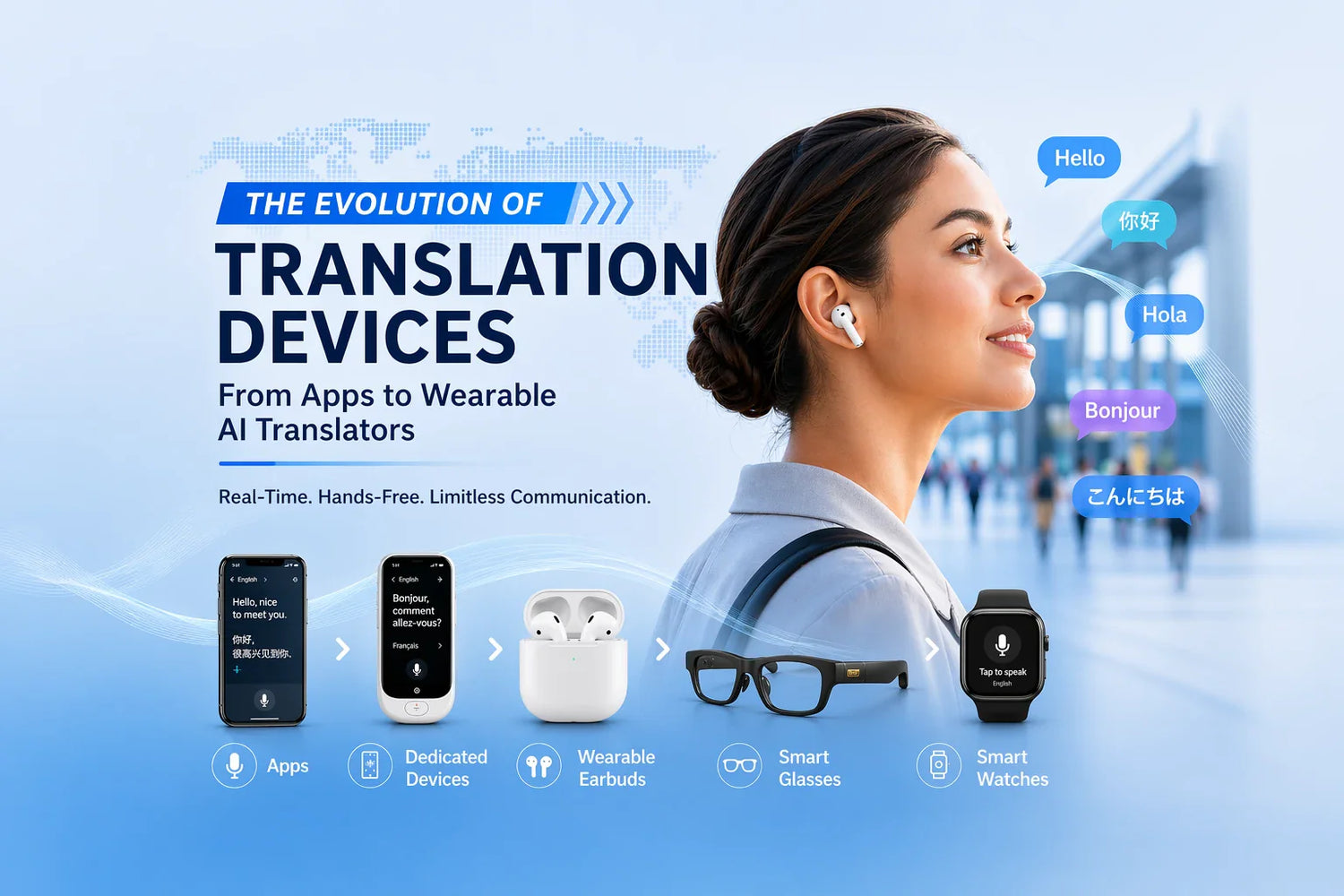
This evolution follows a clear path: from early digital tools to mobile apps, then to dedicated devices, and finally to wearable AI translators that integrate seamlessly into everyday life.
Early Translation Technology: From Dictionaries to Digital Translation Tools
Before digital solutions existed, translation relied on physical tools such as dictionaries and phrasebooks. These were useful for basic communication but often slowed conversations down.
Users had to search manually, interpret meanings themselves, and accept that conversations would be fragmented. While these tools helped bridge language gaps, they were far from efficient.
Digital translation tools improved accessibility, but they still required active effort. Translation remained a task rather than a natural part of communication.
The Rise of Translation Apps and Why They Weren’t Enough
Mobile translation apps marked a major breakthrough. For the first time, users could translate text, voice, and images instantly using their smartphones.
This made translation:
- Faster
- More accessible
- Available anytime, anywhere
However, even with these advancements, apps didn’t eliminate friction in conversations.
Users still had to:
- Speak into a device
- Wait for translations
- Shift attention between the screen and the conversation
As a result, communication became more efficient—but not truly seamless. The experience still felt like using a tool, rather than simply communicating.
The Shift to Translation Devices: Portable Real-Time Translator Technology
To improve the experience, dedicated translation devices were introduced. These portable translators focused entirely on real-time communication.
By combining optimized hardware with AI translation engines, they offered:
- Faster response times
- More accurate voice recognition
- Simplified two-way interaction
For many users, this was the first time translation felt practical in real conversations.
Still, these devices required users to hold and operate them, which meant interaction was improved—but not yet effortless.
Wearable Translation Devices: The Future of Hands-Free Real-Time Translation
The next stage of evolution came with wearable technology. Instead of relying on a separate device, translation became integrated into everyday accessories.
This shift reduced friction significantly, allowing users to communicate more naturally—especially in real-world situations like travel, where solutions such as smart wearable translators are becoming increasingly common.
1. Translation Earbuds: Real-Time Two-Way Translator for Conversations
Translation earbuds enable users to speak and listen naturally while translations occur in real time.
By removing the need for handheld devices, they create:
- More fluid conversations
- Hands-free interaction
- A more natural communication experience
2. Smart Translation Glasses: Live Subtitle Translation in Your Field of View
Smart translation glasses introduce a visual layer to communication by displaying real-time subtitles directly in the user’s field of vision.
This allows users to:
- Stay fully engaged in conversations
- Maintain eye contact
- Access information without looking at a phone
Translation becomes less noticeable and more integrated into the experience.
3. Translation Smartwatches: All-in-One AI Translator and Smart Wearable
Smartwatches further integrate translation into daily routines. By combining translation with health tracking, notifications, and fitness features, they make multilingual communication more accessible without adding extra devices.
This reflects a broader trend: translation is no longer a standalone function—it’s becoming part of a larger ecosystem.
Why Translation Devices Are Replacing Apps: From Tools to Seamless Communication
The transition from apps to hardware is driven by user expectations.
People no longer want to manage translation—they want it to happen automatically.
This evolution can be summarized in three shifts:
- From interaction to automation
- From device to environment
- From function to experience
Wearable translation devices reduce friction to a minimum, allowing communication to feel natural and uninterrupted.
How AI Translation Technology Enables Real-Time Language Translation
Artificial intelligence is the foundation of modern translation devices.
Through technologies like neural machine translation and advanced speech recognition, AI enables:
- Faster processing speeds
- Higher accuracy
- Better understanding of context
As these systems improve, translation becomes more conversational and less mechanical—closer to how people naturally communicate.
Conclusion: How Translation Devices Evolved from Tools to Seamless Communication
The evolution of translation devices reflects a fundamental shift in technology and user expectations. What began as manual tools has transformed into intelligent systems designed to disappear into the background of everyday life.
We’ve moved from:
- Looking up words in dictionaries
- Using mobile translation apps
- Relying on dedicated translation devices
- Wearing AI-powered translation technology
Each stage has reduced friction and brought communication closer to its natural form.
Today, wearable translation devices and AI-powered translators represent the most advanced step in this journey. They don’t just translate language—they enable real-time, uninterrupted communication across cultures and environments.
As translation technology continues to evolve, the goal is no longer just accuracy or speed. It is simplicity—where language differences no longer require effort, and communication happens as naturally as speaking itself.


发表评论
此站点受 hCaptcha 保护,并且 hCaptcha 隐私政策和服务条款适用。